

- Published on
The 4 Pillars of Agentic Commerce Architecture for Shopify Merchants
TL;DR
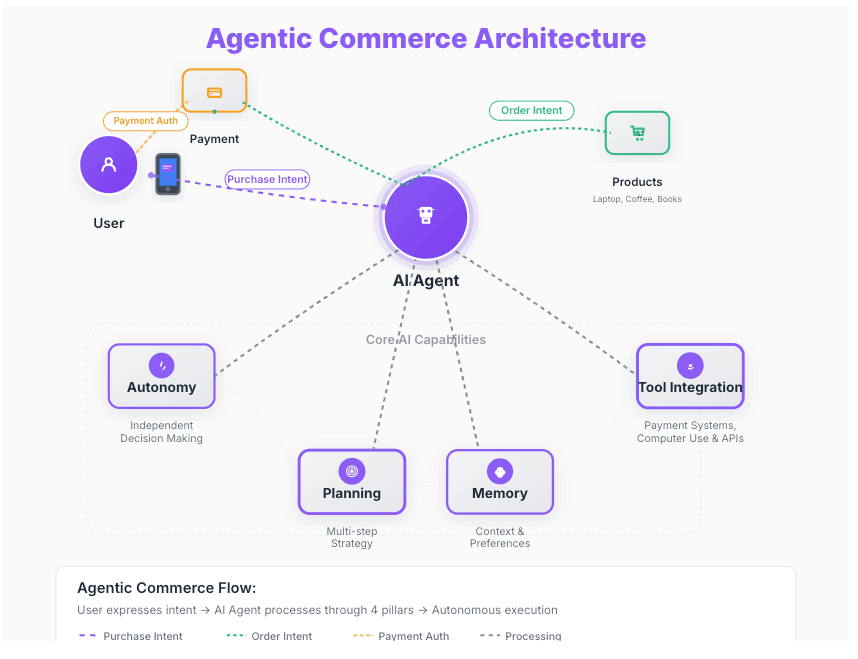
Architecture is the difference between a chatbot that talks and an agent that transacts. To win in 2026, Shopify merchants must understand the four architectural pillars—Autonomy, Planning, Memory, and Tool Integration—that turn AI into a revenue-generating workforce. Stop building flows; start deploying agents.
- Authors

- Name
- Isaac Lewin
- Shopify Architect
- @iliveoffgrid
Why Architecture Trumps "Chat"
In the early days of AI in e-commerce, we were obsessed with conversation. We built "smart" chatbots that could answer FAQs but froze the moment a customer wanted to actually do something—like merge two orders, change a shipping address, or find a product based on a vague "vibe."
In 2026, the conversation is just the interface. The real value lies in the Agentic Architecture underneath.
You're going to see a torrent of agentic commerce.
This "torrent" is powered by systems that don't just predict the next token in a sentence, but execute the next step in a business process. At ShopGuide, we’ve built our agentic engine on four core pillars.
1. Autonomy: Independent Decision Making
Autonomy is the shift from "If-This-Then-That" logic to Independent Decision Making. Traditional chatbots follow rigid trees. If a customer deviates from the script, the bot fails.
An autonomous agent understands the goal (e.g., "Find a gift for a coffee lover under $50") and decides which tools to use and which questions to ask to reach that goal. It doesn't need a pre-defined path; it creates the path in real-time.
2. Planning: Multi-step Strategy
E-commerce is rarely a single-step transaction. It involves a journey from Purchase Intent to Order Intent, and finally to Payment Auth.
The Planning pillar allows the agent to execute a Multi-step Strategy. This means the agent can:
- Research the catalog to find the right variant.
- Check inventory levels via the Shopify Catalog API.
- Apply the correct discount codes.
- Prepare a Universal Cart for the final checkout.
It sees the "big picture" of the transaction and manages the sub-tasks required to close the deal.
3. Memory: Context & Preferences
Generic shopping is dead. The Memory pillar ensures that every interaction is informed by Context & Preferences.
ShopGuide agents remember if a customer preferred sustainable materials in a previous session or if they usually buy for a specific size. This isn't just "personalization" via a tag; it's a persistent understanding of the user that grows more accurate over time, leading to higher confidence and larger cart sizes (AOV).
4. Tool Integration: APIs & "Computer Use"
An agent without tools is just a philosopher. The final pillar is Tool Integration, which connects the agent’s brain to the "physical" world of your store.
- Computer Use & APIs: The agent "sees" your store not just as text, but as a series of actionable tools. It uses the Shopify Catalog API to fetch real-time data and navigates your site like a power-user.
- Payment Systems: By integrating with Stripe’s Agentic Commerce Suite, the agent can handle Payment Auth and secure processing, bridging the gap between "I want this" and "This is paid for."
The Competitive Edge
Merchants who understand this architecture are no longer just "using an app." They are deploying a digital workforce that scales infinitely. When you move from chatbots to agents, you move from answering questions to capturing revenue.
Is your store built on flows, or is it powered by an agentic engine?
Experience the ShopGuide Architecture 🚀
Frequently Asked Questions
What is the difference between a chatbot and an agentic architecture?
A chatbot is primarily designed for conversation and usually follows pre-defined "flows" or scripts. An agentic architecture, like ShopGuide's, is designed for execution. It uses independent decision-making and tool integration (like APIs) to perform complex tasks—such as building a cart or editing an order—without needing a human to guide every step.
How does "Planning" help increase Shopify revenue?
Planning allows the agent to handle multi-step sales processes. Instead of just answering a single question, the agent can develop a strategy to guide a customer from a vague interest to a completed checkout. This includes handling objections, suggesting relevant upsells via the Catalog API, and managing the checkout preparation, which significantly reduces cart abandonment.
Does the "Memory" pillar comply with privacy standards?
Yes. ShopGuide's Memory pillar is designed to store user preferences and context to improve the shopping experience, but it does so within the bounds of modern privacy regulations. The focus is on "transactional context"—remembering what the customer likes to buy and their specific needs—to make the agent more helpful, not to track them across the web.
How does "Computer Use" work for AI agents?
"Computer Use" refers to the agent's ability to interact with web interfaces and APIs just like a human would, but with the speed and precision of a machine. For Shopify merchants, this means the agent can navigate the storefront, interact with the cart, and use back-end APIs to fetch inventory or process order edits, effectively acting as a digital employee.

Master Agentic Commerce
Join Shopify founders receiving weekly insights on AI agents and autonomous growth.
Trusted by top Shopify Plus brands