

- Published on
From Chatbots to Digital Employees: How Noah Müller Is Building the Future of Agentic Commerce

TL;DR
Noah Müller (non-technical founder) built ShopGuide because chatbots don't sell—agents do. Agentic commerce = AI shopping for the customer: tools (catalog, cart, Klaviyo, Judge.me), not just answers. Covers how the agent works in a real store (e.g. waterproof sneakers under $120), embedded help vs. corner bubble, A/B testing for revenue/AOV, deep Shopify API integration (no separate catalog), pricing tiers (Intern/Employee/Manager), and who should get an agent. Practical, founder-focused.
- Authors

- Name
- Anna Moroz
- Shopify Architect
From Chatbots to Digital Employees: How Noah Müller Is Building the Future of Agentic Commerce
Why one non-technical founder decided "chatbots aren't enough", and what that means for your Shopify store.
If you run a Shopify store, you've probably had this thought at least once:
"My chatbot is… fine. But is it actually selling anything?"
That exact frustration pushed German founder Noah Müller to build ShopGuide, an AI agent that behaves less like a FAQ widget and more like a digital employee living inside your store.
This article is a look at how one founder used AI to build an AI product, what "agentic commerce" actually means in practice, and how to tell whether an AI agent makes sense for your store right now.
What does "agentic commerce" really mean?
The phrase Agentic Commerce sounds futuristic, but Noah explains it in a way that's hard to forget:
"Agentic e-commerce is when AI is shopping for the customer."
Today, most stores still operate in a familiar pattern. A visitor lands on your homepage, scrolls, clicks into a product, maybe plays with filters, maybe searches. If they get stuck or confused, there's a chat bubble in the corner that they can choose to open. When they do, a chatbot answers questions, suggests links, maybe shares a discount code, and that's usually where it ends.
In that world, the chatbot is reactive. It waits. It answers. Then it disappears.
An AI agent behaves very differently. It doesn't stop at talking; it uses tools to act inside your store. It can search your catalog in real time. It can add items to the cart. It can modify an order after purchase, as long as it hasn't been fulfilled. It can subscribe a customer to your mailing list through Klaviyo. It can fetch reviews from Judge.me and present them at the right moment.
Instead of saying, "Here are some options, here's a link," the agent is able to say, "Here's the product that fits your needs, and I've already added the right size to your cart."
The distinction is simple but important:
- A chatbot answers questions based on a static knowledge base.
- An agent uses tools to take actions on the customer's behalf.
That shift, from answering to acting, is the core of agentic commerce.

How Does an AI Shopping Assistant Work Inside a Real Store?
Imagine a customer who wants waterproof sneakers under $120.
With a typical chatbot, the customer types a question, gets a few product links, and then has to do the rest: open pages, compare models, check sizing, and add to cart.
With an agent like ShopGuide, the flow is different:
- The customer types the same request.
- When needed, the agent can ask a few clarifying questions (city vs. hiking use, season, fit preference, size) before making a recommendation.
- It uses Shopify's own APIs to search current inventory, filter by price, size, and attributes.
- It suggests one or two focused options instead of a long list.
- When the customer agrees, it adds the product directly to the cart.
If the customer realizes they need a second pair right after purchase, the same agent can edit the order (as long as it's not fulfilled yet), instead of sending them into a complicated support flow.
The experience is closer to messaging a human salesperson than clicking through a static chatbot.
Embedded help, not just a bubble in the corner
One of the defining design choices in ShopGuide is where the agent lives.
Most tools show up as the familiar bubble in the lower-right corner of the screen. It's always there, but it's easy to ignore, and it forces the shopper to stop what they're doing: scroll → feel a need → click the bubble → type a question → wait for an answer.
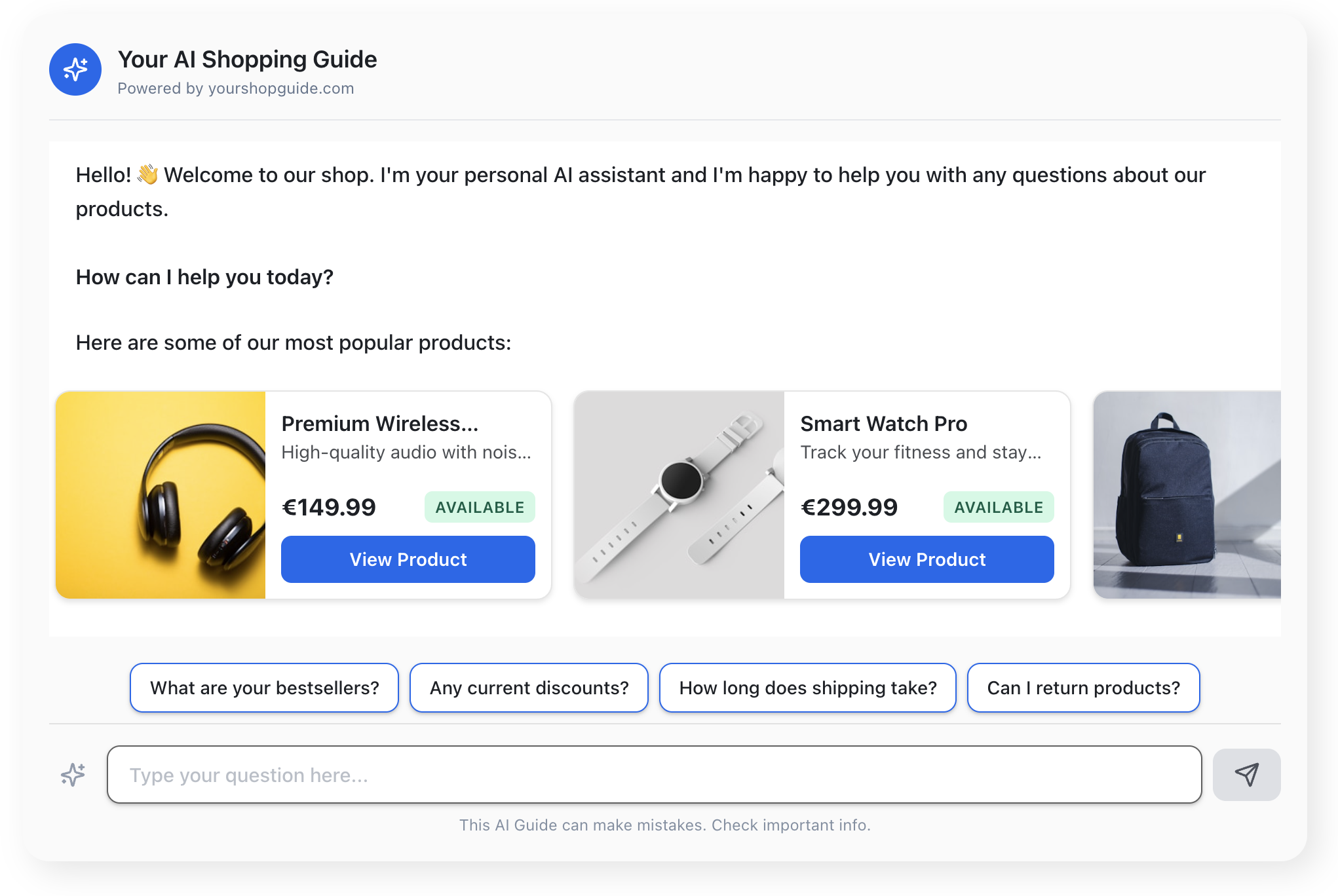
ShopGuide flips that model. Instead of hiding in the corner, the agent is embedded directly into key pages. As customers move through collections, product pages, and the cart, they see the agent in context with one-tap suggestion prompts, more like: scroll → notice a relevant question → click → get an answer.
Because the help is visible at the exact moment of intent, conversations feel like a natural part of the shopping flow, not a separate support channel. That alone tends to drive many more interactions, not because the AI is louder or more aggressive, but because it's built into the experience instead of living in a bubble on the sidelines.
Does an AI Agent Really Increase Revenue and AOV?
For Noah's team, "more engagement" is only the starting point, not the finish line. ShopGuide does increase how often shoppers interact with the store, but the real focus is on complex e-commerce numbers: revenue, average order value (AOV), and conversion.
To measure impact, they use built-in A/B testing: one segment of visitors gets access to the agent, while another never sees it. Then they compare how those groups perform: revenue per visitor, conversion rates, AOV, and the number of orders directly tied to agent-assisted sessions.
Because the agent works through Shopify's own APIs and surfaces data inside the admin, you can see exactly which conversations led to orders, how much those orders were worth, and how traffic exposed to the agent performs against the control group. If those metrics don't move, increased engagement alone isn't good enough; it's a clear signal that the agent isn't doing its job yet, and something needs to change.
How Does Deep Shopify Integration Make It More Reliable?
Another design decision sits under the hood. Many AI chat tools work by copying your product catalog into their own database and working off that copy. That approach can be convenient, but it introduces a new set of problems: pricing and stock can drift out of sync, attributes may not update immediately, and you suddenly have one more system to keep an eye on.
ShopGuide takes the opposite route. It uses Shopify's own APIs for everything — catalog, cart, orders, and key integrations like Klaviyo and Judge.me. There's no separate product database to maintain, no second version of your catalog to forget about. The AI sees what Shopify sees.
All of the relevant information about agent interactions lives inside the Shopify admin as well. You can review transcripts, follow page-by-page customer journeys, and see how those journeys translate into orders without logging into yet another platform.
For merchants, that means the AI feels less like an external widget and more like an employee who has been given proper access to the systems you already use.
How ShopGuide Thinks About the Cost of an AI Agent for Shopify
If you visit ShopGuide's pricing page, you won't see the usual "Basic / Pro / Enterprise" labels. Instead, you'll find tiers that look like roles on a team: Intern, Employee, and Manager, plus a custom plan.
The idea is simple: when you install an AI agent like ShopGuide, you're not just turning on a feature: you're effectively hiring a digital team member.
Each tier maps to store traffic rather than message volume or catalog size. You don't have to estimate how many AI messages your customers will send or worry about token consumption. You look at your monthly visitors, choose the tier that fits, and that's your cost.
The language here isn't just marketing. It reflects how Noah thinks about the relationship between store, customer, and agent.
In his view, the store is the hero of its own growth story. The customer is the hero of their own shopping story. ShopGuide positions itself as the guide helping both of them: the merchant to grow revenue more efficiently, the shopper to find the right product more quickly and with more confidence.
Who's Behind ShopGuide?
Behind the AI there's a small team with very human motivations.
Noah, the founder, doesn't come from a classic engineering background. He built the product with AI as his co-developer, which naturally pushed him toward agentic workflows from day one. If the machine can help him write code, why shouldn't it help merchants sell? His obsession now is straightforward: what else can the agent do inside the store that actually matters?
He's joined by people who found the product as users first. One came in from marketing and sales, after spotting ShopGuide on LinkedIn and wanting to sell it. Another started as a merchant who wanted the app for his own Shopify store and ended up joining the team to help steer growth from a "real-life store" perspective.
They test, watch what happens in live stores, and iterate. It's a very practical approach: less theory, more "did this actually help a merchant this week?"
Is Your Shopify Store Ready for an AI Agent?
Here's a quick way to think about it.
You're on Shopify.
You have regular traffic.
You sell more than a handful of products (and ShopGuide tends to be especially powerful for large catalogs: 1,000+ SKUs).
Customers often ask about sizing, fit, use cases, or comparisons.
Your audience includes a solid share of desktop users, where the embedded experience really shines.
You care about improving AOV and conversion, not just answering support tickets.
You may want to wait if:
- You're still in the early "just getting visitors" phase.
- Your offer is extremely simple and linear.
- Your main pain is support ticket routing, not sales.
If you're on the fence, the best answer is data: run an A/B test, look at revenue and AOV, and decide based on what you see, not on AI hype.
Want to see what an AI agent could do in your store?
If you're curious whether agentic commerce actually makes sense for your specific Shopify brand, the next logical step isn't guesswork: it's a conversation.
Book a consultation with the ShopGuide team.
Talk through your catalog, traffic, and current customer journey, and get a realistic view of:
- Whether an AI agent is a good fit right now
- Where it could have the biggest impact
- What you might want to fix in your data or UX first
Instead of asking "Do I need another chatbot?", you can start asking a better question:
"What would a digital employee inside my store actually do for my customers — and for my revenue?"

Anna Moroz
About author
Anna Moroz is a seasoned copywriter and content producer with over 10 years of experience across the EdTech and tech industries. She has led content teams at international companies and contributed to communication and content strategies for European and global tech, oil & gas, and cultural companies.

Master Agentic Commerce
Join Shopify founders receiving weekly insights on AI agents and autonomous growth.
Trusted by top Shopify Plus brands